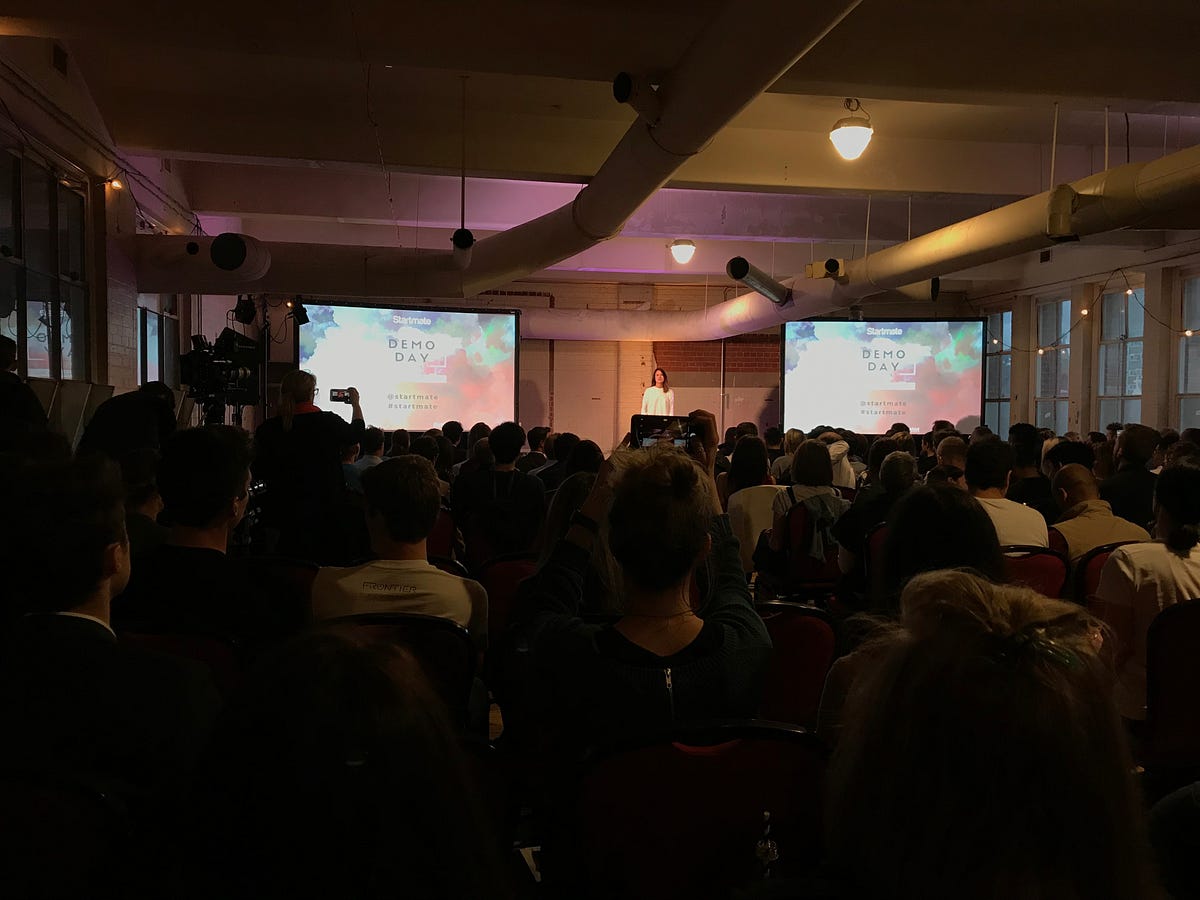
Opening at the Startmate Demo Day/Pitch Night in Collingwood on Oct 11, 2017
Last night I attended the Startmate Demo Day, really a pitch night for this 12 week accelerator program. It was wonderful — startup theatre is entertaining, the Collingwood arts precinct is awesome and there were many familiar and friendly faces in the room. It’s quite amazing to witness how the startup community in Melbourne has grown in the past five years. But a conversation afterwards with Kaj got me thinking again about some of the darker consequences of the transition towards a more entrepreneurial society, at least if we don’t adapt our institutions to better support this shift.
Early this year we hosted an event at RMIT exploring some of these consequences, with a particular focus on the wellbeing of entrepreneurs. Visiting scholar Maw Der Foo shared some research and entrepreneur Avis Mulhall shared her experience on the topic. Here’s a summary of the research on the topic.
The Puzzle of Entrepreneurship and Wellbeing
At first blush the question of the relationship between entrepreneurship and wellbeing can appear something of a puzzle — there are sets of seemingly contradictory data.
On the one hand scholars have found that:
- Entrepreneurs seem to experience higher role ambiguity, health problems and lower work satisfaction as compared to managerial counterparts
- Entrepreneurship-related stress can lead to loneliness and burnout
- Greater economic stress leads to higher depressed affect, which in turn results in greater intentions to withdraw from entrepreneurship
On the other hand research also suggests that:
- The self-employed generally experience fewer negative emotions than those who are employed
- Entrepreneurs have reported lower levels of stress in a large national survey of perceived stress
- Compared with employees, entrepreneurs experience lower blood pressure, lower prevalence of hypertension, higher well-being and more favourable health indicators
So how are we to make sense of this? When we look closer we can see some important distinctions among entrepreneurs themselves. For example, among entrepreneurs, subjective measures of wellbeing are higher for:
- More established enterprises over early stage enterprises
- ‘Second time’ or even serial entrepreneurs rather than ‘first time’ entrepreneurs (whom often neglect the importance of holidays and other aspects of work-life balance)
- Entrepreneurs driven more by ‘opportunity’ rather than ‘necessity’
- Entrepreneurs driven more by passion or a sense of purpose than simply trying to make money
- Female over male entrepreneurs
As is often the case with research examining experiences at work, the key variable undergirding these symptoms appears to be a sense of control, a feeling many first time and/or early startup entrepreneurs often lack. In the absence of a sense of choice and control, ‘busyness’ is often experienced as stress. When coupled with a sense of choice and control, ‘busyness’ can be experienced as a challenge, even an exhilarating one. This is the shift health psychologist Kelly McGonigal refers to as the biology of courage.
So what can we do about stress and a lack of a sense of control, especially in early stage ventures? There are a number of recent studies exploring the effects of various activities on stress reduction, including tai chi ; vacations (which appear to have an effect but fade quickly); kindness based meditation; leisure engagement, behavioural activation interventions; and positive psychology interventions. These are a good place to start.
Further Questions
We dedicated much of the evening to discussing and debating questions from the audience. Here are a few:
- Role identity appears to be a bit of a puzzle, whilst Maw Der suggested role ambiguity can be a confusing experience that challenges the wellbeing of nascent entrepreneurs, Avis cautioned how being anchored by imagined expectations of how to publicly perform the role of a successful (social) entrepreneur can itself be a kind of trap, lead us away from our deeper identities as simply human beings. This would be an interesting topic to explore further.
- What about wellbeing as a ‘global measure’ versus the various components of experience that make up wellbeing? For example how influential is a sense of autonomy at work versus income security? How are these experienced as trade-offs when people are choosing self-employment over organisational employment?
- What about different models of organising entrepreneurial ventures and wellbeing — especially ones that manage stakeholders differently, like worker owned cooperatives?
- How does the entrepreneurial experience really compare to different strata of organisational employees, especially organisations leaders and senior managers?
- What about cultural differences? Do these have an effect on wellbeing outcomes?
- What about the collective wellbeing, not only of the individual entrepreneur, but their family and close friends who may also be affected by the entrepreneur’s choices?
- What about entrepreneurs that try and steer their businesses towards more purposeful work? What happens to their experiences?
- What about employees of early stage start-ups, what are their experiences?
Type Human
These are the kinds of questions we are interested in engaging with at Type Human as we work to reimagine models of work relations that reduce the tradeoffs between autonomy, creativity, dignity and security at work. Please join us if you’re interested in finding answers to these questions too.