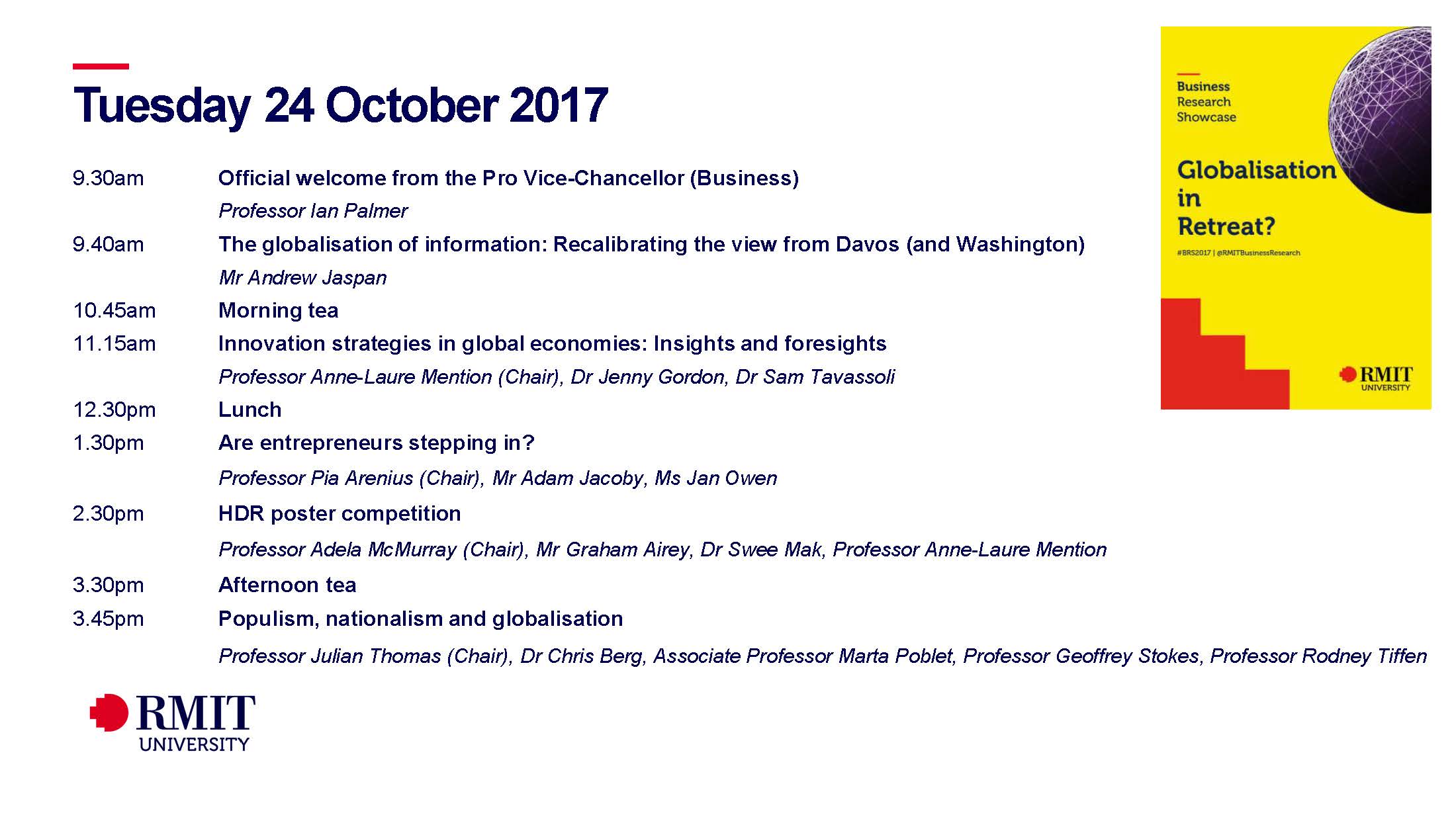
This week RMIT will hold a business research showcase organised around the theme ‘is globalisation in retreat?’ Research priority areas within the college will host conversations regarding current or emerging areas of research. My work here is in the area of entrepreneurship and innovation and we took some time to consider how to locate a compelling set of questions from within our discipline. Here’s some thinking on the topic.
First, is globalisation really in retreat?
At first blush it might seem so. If we conceive of globalisation narrowly in terms of a firm commitment to the free flow of goods, capital and people across national borders; a receding nationalism and growing cultural cosmopolitanism; and a gradual policy harmonisation, even political integration across jurisdictions; we might be persuaded to agree with this assessment. For example, there are reports of flattening global trade and rising protectionist sentiments, declining capital flows across borders, and tightening of immigration policy across a number of countries. The heralded trans-pacific partnership was discontinued, we read of the resurgence of nationalist movements across the world, and of course Brexit and the election of Donald Trump have given much energy to the view that globalisation is fraying at the seams, or rather, as the enthusiasts might put it, that national sovereignty is being actively reasserted.
It might be true that the story of globalisation that emerged after the end of the cold war, instantiated as the triumph of liberal-democratic-capitalism, where our lives would be progressively less mediated by the parochial concerns of individual nation-states, currently has few vocal supporters in politics. Indeed the term ‘globalist’, a project once viewed with suspicion on the Left has now migrated to become a term of derision on the ‘populist’ (and more frequently xenophobic and conspiratorial) Right.
However, if we consider globalisation less as an ideological project driven by national political leaders, and more as a complex set of processes that amount to ‘the intensification of consciousness and social relations across world-space and world-time’, we see a different story. Calls for restrictions on immigration and trade can wax and wane with perceived prosperity (here’s an example from 1896). But the complexity and interdependence of the world techno-economic system shows no fundamental signs of reversal. In fact a recent report from McKinsey Global Institute argues that
“the world has never been more connected, but the nature of those connections has changed in a fundamental way”.
In particular the report highlights that:
- digital platforms are changing the economics of doing business across borders, bringing down the cost of international interactions and transactions;
- small businesses worldwide are becoming ‘micro-multinationals’…where even the smallest enterprises can now be ‘born-global’. They find for example that 86 per cent of tech-based startups they surveyed report cross-border activity;
- individuals are participating in more direct forms of globalisation, using digital platforms to learn, find work, showcase talent, and build personal networks.
Second, are entrepreneurs really stepping in?
“My goals are to accelerate the world’s transition to sustainable energy and to help make humanity a multi-planet civilisation, a consequence of which will be the creation of hundreds of thousands of jobs and a more inspiring future for all.” — Elon Musk
So perhaps ‘globalisation’ is less in retreat and more undertaking a kind of transformation, including some changes to the cast of its leading protagonists. For instance, consider a few recent examples of entrepreneurial interventions:
- Preparations are underway for the colonisation of Mars, led, not principally by nation-states, but by SpaceX and other private enterprises focused on spaceflight.
- Calls for binding international agreements between governments to attenuate the causes of climate change date back to the 1992 Earth Summit in Rio De Janeiro, yet the automotive and solar power storage industries are being repositioned more by the entrepreneurial efforts of Tesla than regulatory interventions.
- Whilst the future of the Euro and other regional fiat currencies may be faltering, we have a born-global system of crypto-currencies whose emergence has been driven by communities of entrepreneurs and investors.
- Beyond digital currencies, Vitalik Buterin and the ethereum community are attempting to reimagine how ‘smart’ contracts function by essentially creating a networked ‘world computer’ that can automatically execute programmed agreements.
- Jimmy Wales, the founder of wikipedia, frustrated with government inability to address media disruption and fake news, is attempting to redesign how global journalism might function by reasserting the centrality of evidence and fact checking through wikitribune.
- Finally, there are a range of entrepreneurs looking towards the capacity of technology and new voting protocols to disrupt the current models of representative democracy. MiVote and Flux are two Australian examples but there are many others.
Many applaud the vision and leadership of these ventures, others will likely view their objectives or means of achieving them with some suspicion. But what they have in common is remarkable aspirations for societal impact beyond the mere success — financial or otherwise—of the firms or founders in question. So how do we make sense of examples like these through the lens of entrepreneurial theory? Are current terms like ‘social entrepreneurship’ or even ‘institutional entrepreneurship’ sufficient to describe and explain what’s happening here? For scholars of entrepreneurship, should we search for new theory or simply make do with the existing, contested concepts?
Third, join us in discussion if these questions intrigue you!
We will be discussing these issues — the systemic impact of innovative entrepreneurs and how to best think about and study it— in dialogue with Adam Jacoby serial entrepreneur and founder of MiVote, Jan Owen, CEO of the Foundation for Young Australians, and Pia Arenius, Professor of Entrepreneurship at 1.30pm on Tuesday 24th of October at RMIT University. The session is open to the public so please join us for the conversation if you’re free and these questions draw you in.