Research suggests the benefits of employee side-hustles might outweigh the costs
5-Second Summary
Employee side-hustles have been a growing workplace trend for sometime, but have accelerated since COVID-19 pandemic.
Surprisingly, research suggests side-hustles can have positive effects on an employee’s primary job, based on the nature of side-hustle work and the reasons employees engage in them.
Leaders should approach questions and policies of employee side-hustles with an open mind, understand the nature of the work and reasons employees engage in side-hustles, in order to assess if the benefits they can bring to a workplace outweigh the costs.
The new normal of remote work has led to an explosion of side-hustles.
Recently, an old friend of mine who now lives in Brazil shared his experiences after attending a local expat meetup. Most people he met there faced similar circumstances to him - negotiating the challenges of how to balance career opportunities, proximity to family, bicultural experiences for their kids and the overall lifestyle aspirations of where to live with their Brazilian spouses.
For this group, the post-2020 normalisation1 of remote work has been a real boon, because it has allowed them to live in Brazil but maintain ongoing work with a company based in Europe, Asia or the USA and, more importantly, get paid at non-local rates. However, what neither of us expected was the number of people who were not only working remotely, but also juggling multiple contracts and jobs. One woman even claimed to be managing three full-time roles in the finance sector at the same time.
Welcome to the side-hustle economy
What’s now called the ‘side-hustle’ has gone by many names - moonlighting, side-gigs, hybrid-entrepreneurship, portfolio work, weekend work or simply the plain old second job. The idea behind it is simple - supplementing one’s primary employment with additional income generating activities. Long before anyone had heard of COVID-19, this trend was growing due the rise of platform technologies that make ‘gig’ work easier, the preference many organisations have shown for hiring freelancers and contractors over permanent staff, and the financial pressures many young people face, such as saving for home down payment and cost-of-living expenses. Although estimates of the size of the side-hustle economy vary, some accounts suggest up to one-third of the workforce across the USA and Europe engages in these activities2, contributing over $1.3 trillion to the US economy, which is roughly equivalent to the entire size of the Australian economy3. The side hustle trend isn’t limited to young people trying to make ends meet, such as hospitality workers driving Ubers between shifts, but there’s evidence even senior executives are building side businesses or engaging in work outside their primary employment responsibilities4.
The COVID-19 pandemic simply accelerated the side hustle trend, like many other changes in our lives. The shift to remote work during the pandemic further loosened the relationship between work tasks, time and space. As more people began to work routinely outside of the office - either from home or elsewhere - they also began blur the lines between work and non-work activities. Some started their work days earlier in the morning, others worked later in the evening or even on weekends. Conversely, many people also started incorporating more non-work activities, such as exercise, household chores, meal preparation, and school pick ups/drop offs, within the traditional 9-to-5 workday.
How should leaders respond to the growth of the side-hustle economy?
So how should leaders respond to this trend? It might seem intuitive to view side-hustles with suspicion, to assume that any additional activities will drain a worker’s finite attention and energy, and thus they are nothing but a distraction that ultimately harms job performance. But research sometimes helps us understand when our intuitions lead us astray, or at least when the story is more complex than it might first appear. Luckily, this was the precise question pursued by a 2021 paper published in the Academy of Management Journal titled “Do the hustle! Empowerment from side-hustles and its effects on full-time work performance” authored by Hudson Sessions, Jennifer Nahrgang, Manuel Vaulont, Raseana Williams and Amy Bartels5.
The good news is that the authors directly address the question most leaders want to know: do employee side-hustles have positive, neutral or negative effects on their full-time work. However, as is common among complex questions in social science, the answer is…it depends.
The authors found that side-hustles can have both “enriching and conflicting” effects on the primary, full-time job. But it depends on what employees do for a side-hustle and why they do it.In more precise terms, the two determining factors are:
Side-Hustle Complexity: or the characteristics of the work involved in a side-hustle.
Side-Hustle Motives: or the reasons why employees participate in side-hustles.
Let’s dig into the research a bit further to understand how these two factors interact to produce either positive or negative effects on primary job performance.
How do side-hustles impact employees and their job performance?
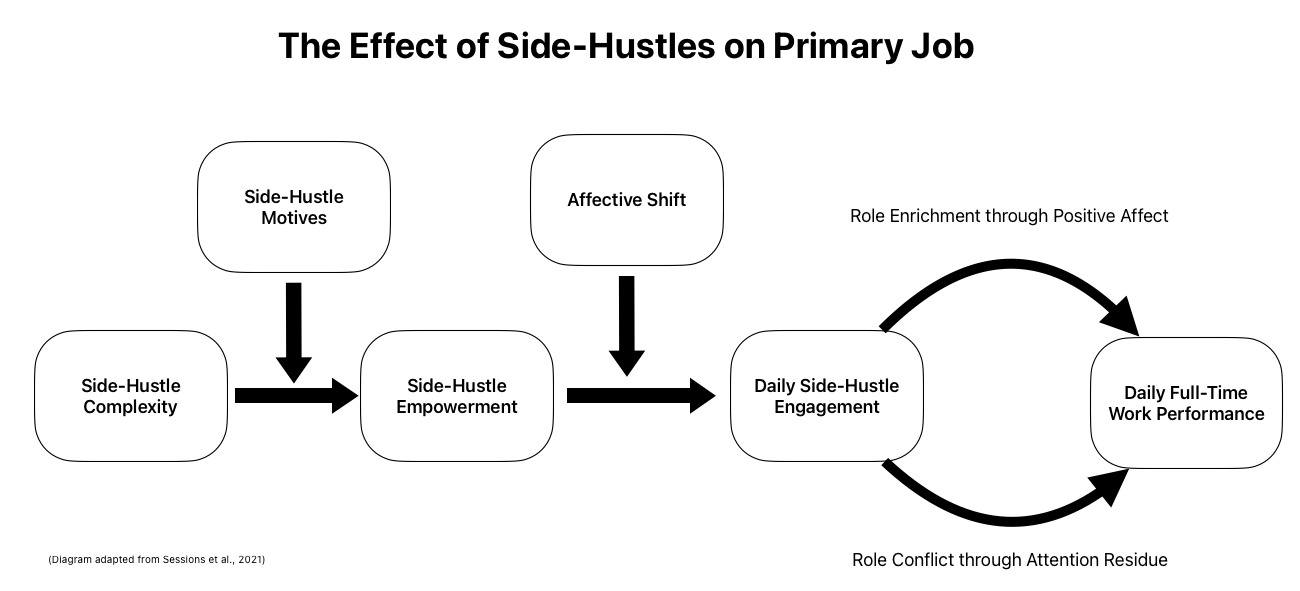
The authors (Sessions et al.) developed and tested a model articulating the relationship between the experiences of employees engaging in side-hustles and the effects on their primary job across two studies involving 417 employees. The model is presented above, but I’ll explain each of the parts and how they fit together below.
Side-Hustle Complexity: Just as not all jobs are created equal, neither are all side-gigs. The authors found that side-hustles that have richer task characteristics lead to a greater sense of empowerment, which can ultimately have positive spillover effects on the primary job. What are richer task characteristics? Generally, those that involve a sense of autonomy, authenticity, significance, competence, skill variety and positive feedback. In short, as I’ve written about previously6, the kind of work people find meaningful. The tasks themselves could be quite varied - designing a new product for a business, working as a personal trainer, hosting a podcast, or writing a paid newsletter - but it’s less likely to be merely completing simple paid tasks on Amazon Turk.
Side-Hustle Motives: The reasons employees engage in side-hustles also matters, primarily because they influence (moderate) the relationship between the side-hustle complexity and sense of empowerment. The authors tested the effects of four distinct motivations for engaging in side-hustles. These were self-enhancement, or increasing pay and prestige; self-transcendence, or connecting with and serving other people; openness to change, or pursuing new intellectual and emotional experiences; and conservation, or a desire for security - perhaps as a hedge against the potential loss of a primary job. They found that three of these motives - self-enhancement, self-transcendence and conservation - all strengthen the relationship between side-hustle complexity and empowerment, but mere openness to change had no observable effect. This suggests simply dabbling in extra activities out of curiosity might be insufficient to the sense of empowerment with positive spillover effects on their primary job.
Side-Hustle Empowerment: When employees are motivated by combinations of self-enhancement, self-transcendence and conservation to engage in complex side-hustles, or those composed of rich tasks, they can experience a sense of side-hustle empowerment. This is a range of cognitive and affective experiences involving “self-determination, impact, competence and meaning”. This isn’t hard to understand - it’s simply that positive feeling we get when we’ve learned to do something well, accomplish something difficult, or impact someone positively through our work.
Daily Side-Hustle Engagement: This sense of empowerment stemming from side-hustle task competence can translate into energy and enthusiasm that sustains side-hustle engagement. Engagement is sustained when people perceive their work is meaningful; that they have the skills and capabilities to do it well; and that they are not afraid of negative consequences arising from performing their work. Side-hustle empowerment and engagement are clearly related and overlap to an extent, but one of the core insights of the paper is that these positive cognitions and feelings can spillover, or be carried into positively interacting with an employee’s primary job.
Affective Shift: How does this relationship between side-hustle empowerment and engagement unfold? It’s partly influenced (moderated) by how employees feel about their primary job. You might have noticed that your level of engagement at work doesn’t remain constant, but how you feel about work fluctuates depending on many factors, such as the tasks you’re working on, your relationships with colleagues, the time of day and even what’s happening in your life outside of work. The study of the relationship between how various factors influence our thoughts, feelings, motivations and overall engagement at work is called the affective shift model of work engagement7. Sessions et al., found that the positive relationship between side-hustle empowerment and daily engagement is even stronger when employees have negative affective experiences in their primary role. In other words, side-hustles can provide a positive outlet that contrasts with or compensate for negative experiences in their full-time roles.
Role Enrichment Through Positive Affect: These positive cognitive and affective experiences stemming from side-hustle engagement are not simply fleeting, but become psychological resources that can be carried over between domains. This is why these resources are said to ‘spillover’, where the energy, enthusiasm, sense of self-efficacy and confidence developed through side-hustle engagements can enrich, or positively impact, an employee’s primary role. This is precisely what the authors of the paper found, that these additional resources generated through daily side-hustle engagement do have a positive impact on primary job performance.
Role Conflict Through Attention Residue: However, there are also some trade-offs. They also found some evidence that side-hustles can drain cognitive resources, through attention residue, or the lingering effects of a previous task on the subsequent task. We can’t escape attention residue, and it’s one of the key reasons that multi-tasking at work is generally a bad idea. We tend to do our best work when we’re deeply focused on a complex task with minimal distractions8. Each switch between tasks involves a cognitive cost that tends to reduce how effective we are. Our energy and attention are ultimately finite, and the authors found some evidence that side-hustles can distract attention from primary tasks. However, these cognitive costs were generally found to be outweighed by the positive affective effects of side-hustle engagement. In other words, even if sometimes distracted or tired, the energy, enthusiasm and sense of self-efficacy garnered through side-hustle engagement outweighed the cognitive costs.
In summary, the paper found that side-hustles can offer employees a sense of empowerment when the work is meaningful, and these engagements can help employees develop psychological resources that can spillover to positively impact their primary role. The assumed cognitive costs of engaging in side-hustles are a real concern, but in general these costs are outweighed by the affective benefits of employees happily engaged in projects outside of their primary role.
What does this research mean for leaders concerned about employee side-hustles?
This research suggests that leaders should approach the growing trend of employee-side hustles with a nuanced and open-minded perspective. The reality is, so the numbers suggest, that more than a third of the workforce are engaging in some kind of additional work. Understanding the reasons employees engage in side-hustles, and the nature of what they do, is likely a wiser response to the trend than instinctive suspicion or reactive punishment. It’s quite likely that some of the more capable employees seek out additional work as a challenge, to work on more complex problems or have more direct interactions with the beneficiaries of their work. Sometimes, side-hustles are chosen specifically as a strong contrast with one’s primary role - perhaps an accountant wants something active, like working as a crossfit instructor, as a break from a sedentary day job. But in many cases, there’s likely an overlap of skills and abilities cultivated outside of work that might also be put fruitfully to work inside a primary role. This won’t always be appropriate, after all, part of the attraction of side-hustles is the autonomy and control that workers have over this kind of work. However, as the findings of this research indicate, the skills and experiences employees develop through side-hustle engagement can still enrich their primary role. So the next time you hear about employee side hustles, resist the urge to hit the panic button. Instead, take a deep breath, (perhaps revisit this post), and have an open conversation with them about what they’re up to and why. Who knows, you might even discover they can bring something different to your workplace. After all, hustle makes things happen.
Clark, D. 2018. How to figure out what your side hustle should be. Harvard Business Review. Retrieved from [https://hbr.org/2018/01/how-to-figure-out-what-yourside-hustle-should-be](https://hbr.org/2018/01/how-to-figure-out-what-yourside-hustle-should-be).